


What makes good fashion product copy?
A good product description answers, in a few sentences, the questions a customer would ask a salesperson in-store: how does it fit, how does it feel, when would I wear it, and how do I wash it? Then come the facts a customer wants to scan, such as composition and fit.
A generic text like These beautiful pants are a must-have for every wardrobe helps no one. Specifics work better: wide legs, high waist, soft cotton, easy to pair with a basic top. That is also what search engines and language models pick up when someone searches for wide cotton pants.
Keep the structure consistent for each product group. Your entire category page will look consistent, even when the copy is written by AI.
| Component | What's included | Length |
|---|---|---|
| Product title | Brand, type, key feature, color | 40 to 70 characters |
| Opening sentence | The feeling or occasion: where you wear it | 1 sentence |
| Description | Fit, fabric, details, styling tip | 3 to 5 sentences |
| Features | Composition, closure, pockets, length, model size | 4 to 8 bullets |
| Care instructions | Care symbols in text, for example 30 degrees, do not tumble dry | 1 line |
| SEO title | Keyword first, brand after | up to about 60 characters |
| Meta description | Promise plus specific feature | 140 to 160 characters |
Define your brand voice
By default, AI writes in a flat and somewhat exaggerated way. The difference comes from a fixed set of rules: your brand story, tone of voice, target audience, whether to address the reader directly, words you never use and how long a text may be.
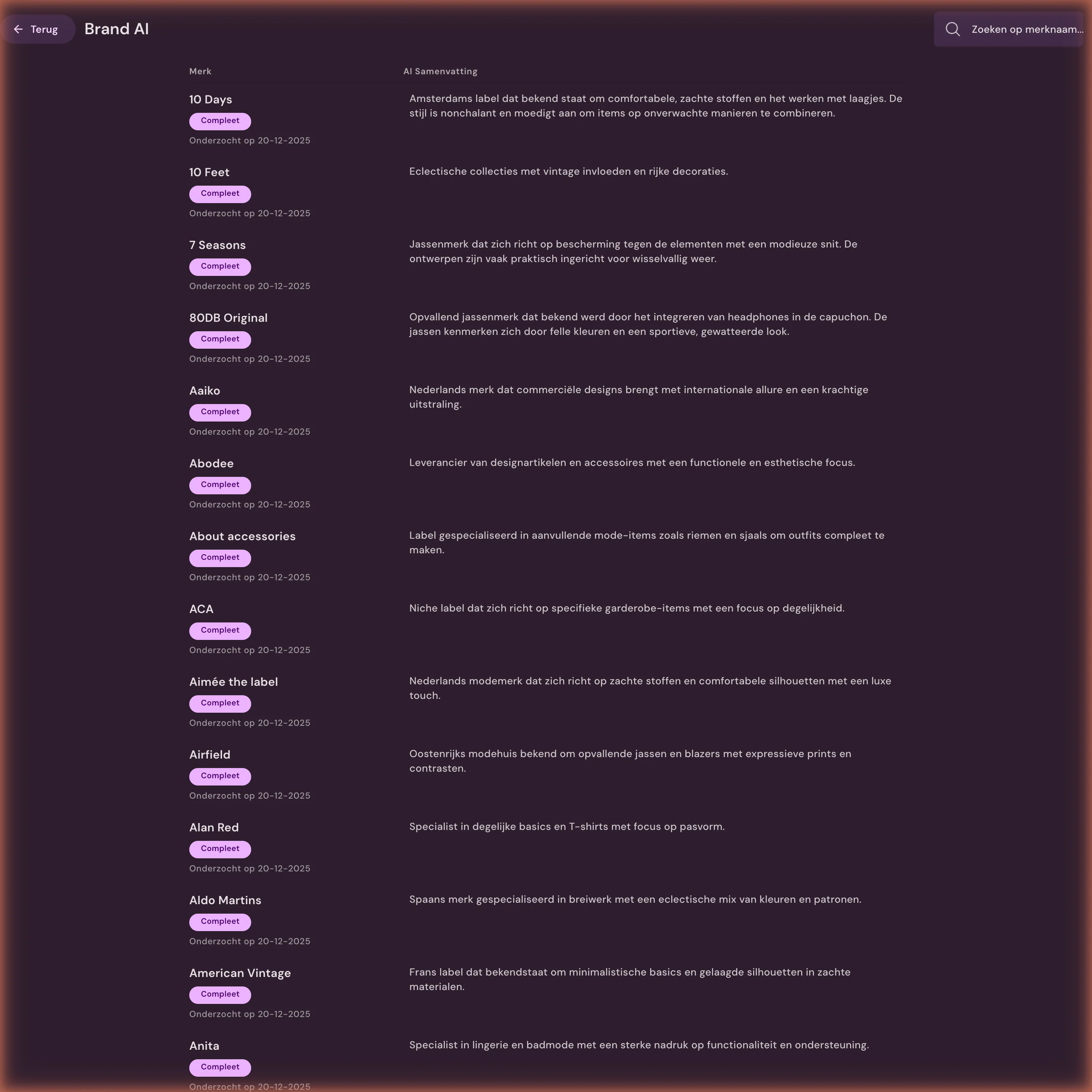
Define those rules once and apply them automatically to every text. For a multibrand store, it also helps to have a short summary for each brand: what the brand stands for and which fabrics and silhouettes are typical.
Season matters too. You describe linen pants differently in March than in October, and a collection for next season needs different styling tips than the current one.
No made-up specifications
The biggest risk with AI-generated text is that the model invents facts: an inside pocket that is not there, wool when the item contains polyester, or an incorrect length. This leads to returns and complaints, and for material composition it can also create problems with labeling rules.
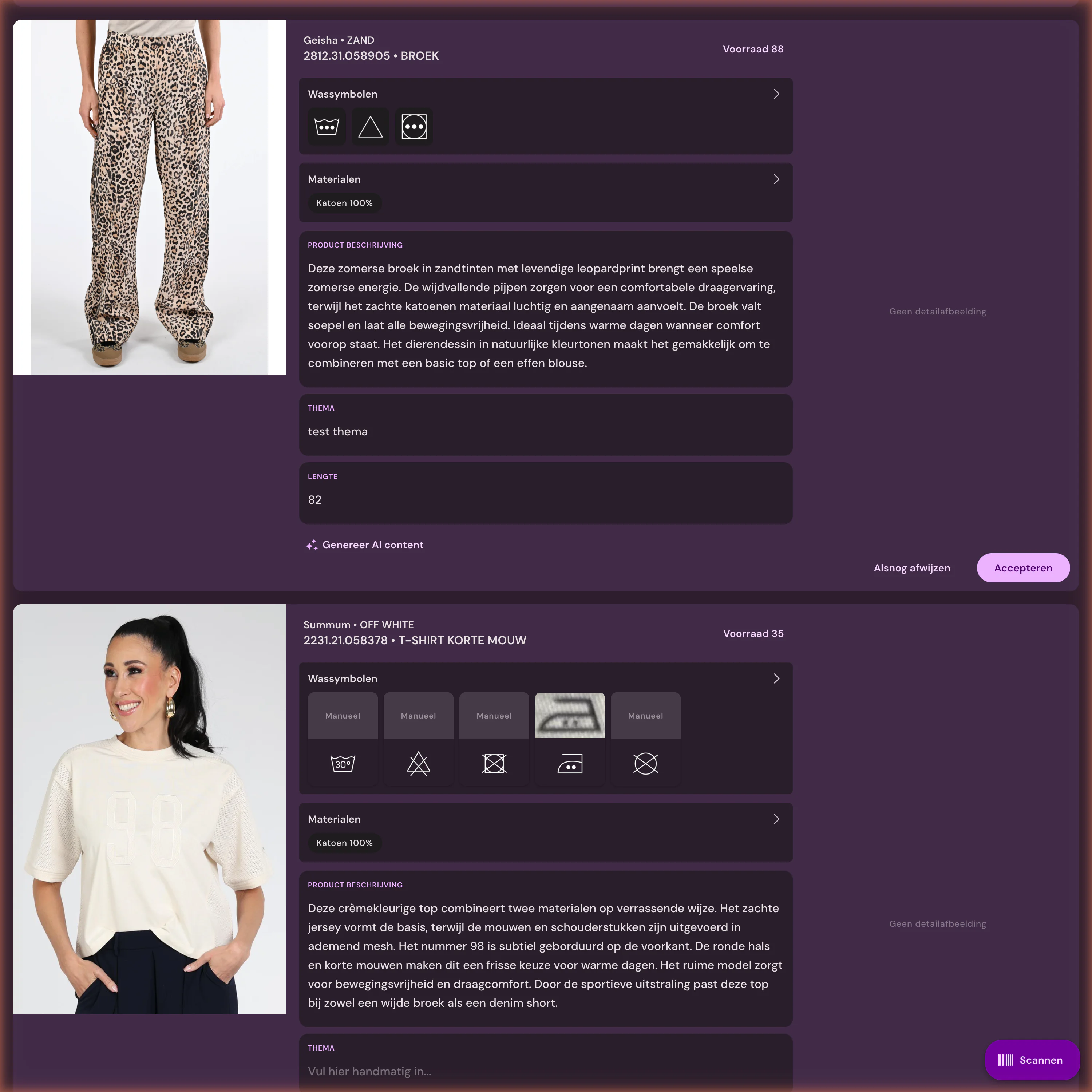
The solution is a specs guard: the text may only mention facts that are in your product data or visible in the photo. Facts from your own feed or ERP always take priority; additional details from sources such as the brand's website can only add information and must never contradict your own data.
For photos, the rule is: describe only what you see, and do not refer to the photo in the text. If there is no model photo, the text does not say anything about how the item fits on the body.
Always give the AI the composition, fit, and care instructions. The better the input, the less it has to invent.
Multilingual and SEO fields
If you also sell in Germany or Belgium, you do not want to write in Dutch first and then have it translated. It is better to generate text for each language directly from the same product data and brand rules, so the wording and search terms are right for each country.
Each product needs an SEO title and meta description in addition to the description. In practice, these are the items most often forgotten, even though they determine how your product appears in Google and in answers from AI assistants.
With an integration to your webshop, those fields are sent to the right product for each language. In Shopware, examples include description, metaTitle, and metaDescription.
Review: check the exceptions, not everything
With thousands of items per season, you cannot read every text. Set per brand or collection whether texts are approved automatically or reviewed by an editor first.
A practical approach: review the first fifty texts for a new brand in full, then switch to spot checks. Adjust your brand rules if you see the same mistake repeatedly, instead of correcting each text individually.
When AI copy is not the best choice
For a handful of hero products or a private label with a strong story, a copywriter is often better. They write one piece of copy that really stands out; AI is strong at creating hundreds of good texts, not that one campaign line.
AI is of little value without product data as well. If you do not know the composition, the AI cannot know it either. First make sure material and care instructions come in, for example from Fashion Cloud or by scanning the care label.
| Approach | Cost per product text | Suitable for |
|---|---|---|
| Freelance copywriter | €5 – €25 | Hero products, private label |
| Write in-house | 10 to 20 minutes of working time | Small collections |
| AI with product data and brand rules | from €0.01 | Complete collections, multiple languages |
How Photopilot does it
Photopilot combines the product photos, your item data, materials and care instructions (from Fashion Cloud, your ERP, or the scanned care label), a brand summary, and your own writing rules into one text per language. You choose the language model yourself, always from the latest models.
A fully enriched product costs from €0.01; the price depends on the number of languages and the text length. Approved copy is in your web store within minutes.